Training Tip: Q&A With Clinton: Ground Tying
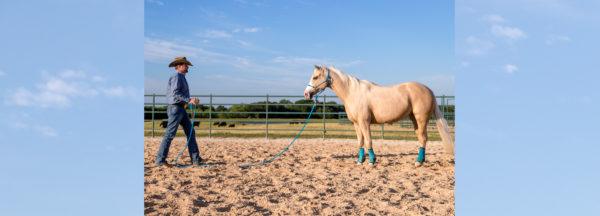
Question: I solved my gelding’s old habit of occasionally pulling back by using the Aussie Tie Ring, completing the Fundamentals, starting on the Intermediate, as well as hobble training him. Now I’m interested in advancing his ground-tying skills. I’ve started slowly adding it to our routine as best I can. Where can I find info on this specifically? – Griffith361
Clinton’s Answer: Great work, mate! You can find step-by-step instructions on how to teach a horse to ground tie in the Trick Training Series. We teach ground tying in the Trick Training Series because in the refinement stage of each trick, the horse needs to hold his position for an extended period of time while you have the option of walking around him, desensitizing him, etc. That would be difficult to do if your horse didn’t know how to ground tie from a standing position to begin with. Most horses will stand still as long as you’re standing directly beside them, but as soon as you walk away, they think they’re free to do whatever suits them. Ground tying teaches the horse to be responsible for staying where you put him, without having to babysit him.
The basic concept of teaching ground tying to a horse is to make the right thing easy and the wrong thing difficult. Hold the very end of the long line so that the rope’s slack is on the ground, and then walk away from the horse. Every time the horse moves his feet when you walk away from him, make him feel uncomfortable by hustling his feet backwards. When he does stand still, leave him alone. Because horses are basically lazy creatures, they would always rather stand still than move their feet, often times, the worst punishment you can give them is making them hustle their feet and sweat.
It’s important not to protect the horse from making the mistake of following you. Hold the end of the long line, but act like you don’t have it. Dare the horse to make a mistake, and then correct him for it. If you protect him by trying to keep him from making a mistake, he’ll never learn to be responsible for his own actions.
Before long, your horse will realize that if he stands still as you walk away, he gets to rest. If he moves, he has to work hard. The more black and white you can make this concept for your horse (standing still is the best option because he gets to rest), the quicker he’ll catch on.
You’ll build on that concept, gradually being able to walk farther and farther away from the horse, until eventually you can drop the long line on the ground and your horse will stand glued to the spot.
Looking for more training tips? Check out the No Worries Club www.noworriesclub.com.
