Training Tip: Ask Clinton: Horse Drags Her Feet
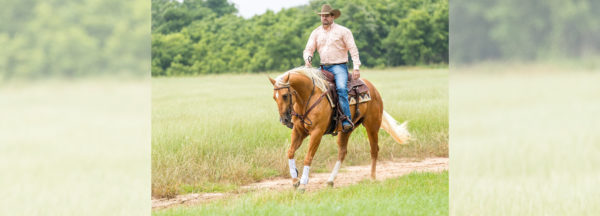
Q: I have an 8-year-old Quarter Horse mare that barely moves. She is cutting bred and is very athletic, but she drags her hind feet and if I’m not constantly pushing her on, she walks and trots at a turtle’s pace and will break down to the trot from the canter. I try to use the “ask nicely, tell, yell” method and it works for about three strides and then I have to ask again. It gets very frustrating. I know she can move a little faster. Is there anything I can do? – Alison
A: The answer to fixing your problem is to work on establishing a good “go” button with transition-type exercises, where you get to practice a lot of go, then transition, then go, then transition, to get the horse good at taking your cue to move her feet seriously. Exercises to practice are One Rein Stops, Yield to a Stop, and Bending Transitions (all found in the Fundamentals Kit). You want your horse to respect your leg cues enough so that when you gently squeeze her sides and ask her to speed up, she does so without a fuss. Not only that, she should maintain that gait and pace unless you tell her otherwise.
If you find yourself constantly pecking at your horse to keep her in a gait, it’s a dead giveaway that your basics aren’t good enough. You need to spend some quality time working on impulsion exercises from the Fundamentals, such as the Cruising Lesson, Follow the Fence, and Diagonals.
When you correct your horse, you should get an immediate response from her and she shouldn’t keep making the same mistake. If she does, it means you’re not being effective.
To get a horse to speed up, we squeeze their sides with the calves of our legs. If they don’t respond, we cluck twice. If they still ignore us, we use the end of the mecate or a dressage whip to spank their hindquarters. And we keep spanking with rhythm and increasing the pressure until we get a response. When you’re correcting your horse, get in and get out and be black and white. Don’t be a nagging mother.
It’s also important to consider your horse’s natural pace. She shouldn’t be breaking gait, but just like people, horses have their own natural flow or style of moving. Take me for example: I’m naturally a fast walker. I get from point A to point B in a very quick, “I’m on a mission” sort of style. Other people walk in a very slow, feet-shuffling, “I’m going to my own funeral; I’m in no hurry” manner. That’s just their nature. And just as it’s not natural for me to slow down and act casual, it’s not natural for them to walk with urgency. Neither one of us is wrong; we’re just different.
We can both certainly change our pace—I can slow down and they can speed up—but it takes a great deal of concentration. The same is true of horses. The old ranch gelding probably doesn’t have as fast a walk as the Thoroughbred off the track does. Just as the 15-year-old draft cross isn’t going to hustle down the trail like the 5-year-old Arabian. Or the Shetland pony isn’t going to be able to easily stay up with a long-strided Quarter Horse.
