Training Tip: Horses are Creatures of Habit
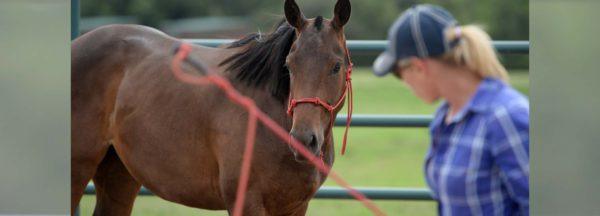
Many of the behaviors our horses develop are because we’re creatures of habit. Our horses pick up on our daily routines quickly and then find ways to work around us. In time, this can create some big dramas. Say one day you go to bridle your horse and he’s a little resistant. No big deal, right? You recognize him doing it, but you’re in a hurry and get on with your training session. Besides, if it turns into a problem, you know how to address it.
Within a few days, when you go to bridle him, he raises his head, and the issue just snowballs from there until it is a big situation where he’s throwing his head up in the air and racing backwards as soon as you approach him with the bridle. Now, instead of it being a little resistance issue that you could have solved in five minutes, it’s become a huge problem that’s going to take several days of consistent work to fix.
The flip side is also true. Little positive behaviors can turn into big, good things. For example, once a horse knows how to do the Fundamentals exercise, Yield the Forequarters, when we change sides of the horse while working with him, instead of us walking around to the other side of the horse, we ask the horse to move his feet around us. It’s not like we set aside a specific time during a training session to teach a horse this; we just chip away at it a little bit throughout every training session. Doing that, throughout the course of a day, a horse may get to practice changing sides 20 to 30 times. That adds up to a lot of repetition in a fairly short amount of time, and before long, it becomes second nature to him.
Another great example is how we teach our horses to lower their heads when we go to halter or bridle them. Once we teach the horse how to lower his head using the Intermediate level exercise Touch and Rub: Poll, any time we halter or bridle him, we ask the horse to lower his head to our belt level and then tip his head toward us while we halter or bridle him. We chip away at it a little every day, and it gets a little bit better every day. Eventually, as soon as we put our hand over the horse’s head, he lowers his head and waits for us.
If you’re consistent about practicing these little things with your horse, it’s easy for him to develop good habits in a short amount of time. It doesn’t take a big, long training session. On the other hand, if you’re not diligent and allow the little things to slip and become bad habits, it’s a lot harder to reverse. It becomes a big project that can’t be fixed in one day. Instead, it’ll take you a couple of weeks to sort out.
We’ve all heard Clinton talk about the rule of three when training a horse. The first time you do something to a horse, you plant a seed. The second time, it becomes a habit. If it’s a good thing, it’s a good habit. If it’s a bad thing, it’s a bad habit. The third time, it becomes an ingrained habit. Does that mean that after three repetitions your horse is trained forever? No! You’ve got to do a lot of repetition to get a horse to the point of acting as if they don’t know any other way to behave.
Looking for more training tips? Check out the No Worries Club. Have a training question? Submit it on our website.
